Neon Rush



Neon Rush Wiki
Summary
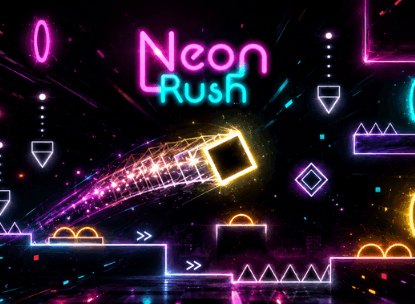
Neon Rush is a meticulously crafted action-rhythm game that places players in control of a small cube navigating a dazzling, neon-lit world. The game seamlessly blends fast-paced obstacle avoidance with an energetic musical score, creating an immersive experience that demands both precision and reflexes. Each level presents a unique arrangement of spikes, pits, and traps, requiring the player to time their jumps perfectly. A single mistake results in an immediate restart, reinforcing the game’s high-stakes, trial-and-error nature. This design philosophy appeals to enthusiasts who thrive on mastering challenging sequences and achieving flawless runs. The vibrant visual style, coupled with progressively increasing difficulty, ensures that every session feels fresh and engaging. Neon Rush is not merely a test of hand-eye coordination—it is a rhythmic dance where the player must synchronize their actions with the beat of the environment. For those who enjoy games where success is earned through perseverance and pattern recognition, Neon Rush offers a polished, addictive loop that rewards practice and patience.
zards. Successful navigation requires a combination of quick reaction time and a calm, focused mindset. Because the cube moves at a constant speed, the challenge lies entirely in timing. A jump that is too early or too late will result in failure, forcing the player to restart the level from the beginning. The game encourages multiple attempts, as each replay helps the player memorize obstacle placements and refine their timing. Once familiar with a level’s sequence, the player can execute near-flawless runs, completing stages faster and with greater confidence. Neon Rush also introduces subtle rhythm elements—the music often mirrors the tempo of the obstacles, allowing players to use auditory cues to guide their jumps. For newcomers, the best approach is to start slowly, focus on one obstacle at a time, and gradually build muscle memory through repeated practice.
Key Features
Neon Rush distinguishes itself through several key features that elevate it above typical clicker or idle games. First, its vibrant neon aesthetic creates a visually striking environment that changes with each level, keeping the experience fresh and immersive. The use of bold colors, glowing trails, and dynamic backgrounds enhances the sense of speed and urgency. Second, the integration of rhythm and music is central to the gameplay. The soundtrack is carefully composed to align with the pace of obstacles, allowing players to develop a natural sense of timing. This audiovisual synergy transforms each level into a mini-performance, where success feels like a well-executed choreography. Third, the game employs a progressive difficulty curve. Early levels introduce basic obstacles and simple patterns, while later stages incorporate complex sequences, faster speeds, and multi-layered traps. This gradual escalation ensures that players are constantly challenged without feeling overwhelmed. Fourth, the design emphasizes replayability. Because each level can be attempted repeatedly, players are motivated to improve their performance, aiming for faster completions and cleaner runs. The lack of checkpoints or continues heightens the tension, making every successful jump feel rewarding. Finally, Neon Rush is part of a family of similarly styled games—such as Rotate Rush, Drift Rush, and Curve Rush—but it carves its own niche by focusing exclusively on single-axis jumping and rhythm. For game enthusiasts who value precision, pattern learning, and a satisfying difficulty curve, Neon Rush delivers a compact yet deeply satisfying experience.
Precautions/Tips
To maximize enjoyment and progress in Neon Rush, players should keep several practical considerations in mind. First, patience is essential. The game’s restart-on-failure mechanic can be frustrating, but each attempt is a learning opportunity. Instead of rushing through levels, take time to observe the obstacle layout before beginning. Mental mapping of trap positions and jump timings will reduce the number of restarts needed. Second, minimize distractions. Because the game relies heavily on precise timing and visual attention, playing in a quiet environment with good lighting can significantly improve performance. Turn off notifications and avoid multitasking to maintain focus. Third, pay attention to audio cues. The game’s music is not merely decorative—it often speeds up or changes rhythm just before a tricky obstacle section. Learning to synchronize your jumps with the beat can provide an edge over purely visual reaction. Fourth, practice consistency over speed. Many players try to complete levels as fast as possible, but this often leads to careless mistakes. Focus on making each jump accurately, even if it means a slower overall time. Speed will naturally improve as you internalize the level patterns. Fifth, take breaks. Extended sessions of high-intensity gameplay can lead to mental fatigue and diminished reflexes. Stepping away for a few minutes helps reset focus and prevents burnout. Finally, explore similar games like Rotate Rush or Drift Rush after mastering Neon Rush, as they offer complementary challenges that refine different skill sets—rotation control, drift precision, and curve navigation—all while maintaining the same fast-paced, neon-infused aesthetic. By following these tips, players can transform Neon Rush from a frustrating gauntlet into a rewarding rhythm journey.
Neon Rush Frequently Asked Questions
Q: What is Neon Rush?
A: Neon Rush is an exciting action-rhythm game where you control a cube navigating obstacles in a vibrant neon world.
Q: How do you play Neon Rush?
A: The cube automatically moves forward; you just need to jump at the right moment to avoid spikes, pits, and traps along the way. Observe the obstacle arrangement, stay calm, and react quickly.
Q: What happens if you make a mistake in Neon Rush?
A: A single misstep means you have to start over from the beginning of the level.
Q: What are the key features of Neon Rush?
A: It features fast-paced gameplay, energetic music, and progressively increasing challenges across each level.
Q: Can you replay levels in Neon Rush?
A: Yes, if you haven't passed a level, you can replay it. Each attempt helps you remember the path and perform more accurate jumps.
Q: Where can you play Neon Rush?
A: You can play Neon Rush now at the website mentioned in the content (the specific URL is not provided, but the game is available to play online).
Q: What are the similar games to Neon Rush mentioned in the content?
A: Rotate Rush, Drift Rush, and Curve Rush are listed as similar games.
Q: What is Rotate Rush?
A: Rotate Rush is a game where you control and rotate your character to overcome unexpected challenges.
Q: What is Drift Rush?
A: Drift Rush lets you experience high-speed drifts on challenging curves.
Q: What is Curve Rush?
A: Curve Rush involves navigating winding tracks that require quick reflexes and precise control.
Q: What are clicker games?
A: The content lists many clicker games such as Kiwi Clicker, Pizza Clicker, Cookie Clicker, and others, but does not provide a definition. They are a genre of games typically involving repeated clicking to progress.
Q: What are idle games?
A: The content lists idle games like Cookie Forge, Titan Clicker, Pickaxe Crusher Idle, and Idle Train Empire Tycoon, but does not define them. Idle games often progress automatically even when the player is not actively playing.
Q: What are io games?
A: The content includes "Io Games" as a category but does not list specific io games or provide a definition.
Q: What is the goal in Neon Rush?
A: The goal is to conquer every level, set new records after each playthrough, and test your speed and reflexes.
Q: Is there a discussion feature for Neon Rush?
A: Yes, there is a "Discuss Neon Rush" section where you can agree to terms and conditions before participating.
Q: What are some other clicker games listed under "Similar Games"?
A: Examples include Kiwi Clicker, Pizza Clicker, Cookie Clicker 3, Cookie Clicker 4, Tung Sahur Clicker, and many more.
Q: Which game is described as having "energetic music"?
A: Neon Rush is described as having energetic music combined with engaging gameplay.
Q: What does the "How to Play" section advise for overcoming obstacles?
A: It advises to jump at the right time, observe the path carefully, and practice to improve performance.
Neon Rush Reviews
How To Play Neon Rush
The core gameplay of Neon Rush is deceptively simple yet deeply engaging. The player’s cube moves forward automatically along a straight path, eliminating any need for complex directional inputs. The primary action is jumping: tapping or clicking at the right moment to clear obstacles such as spikes, gaps, and moving barriers. Each level features a distinct obstacle layout, and the player must observe the path ahead carefully to anticipate ha